
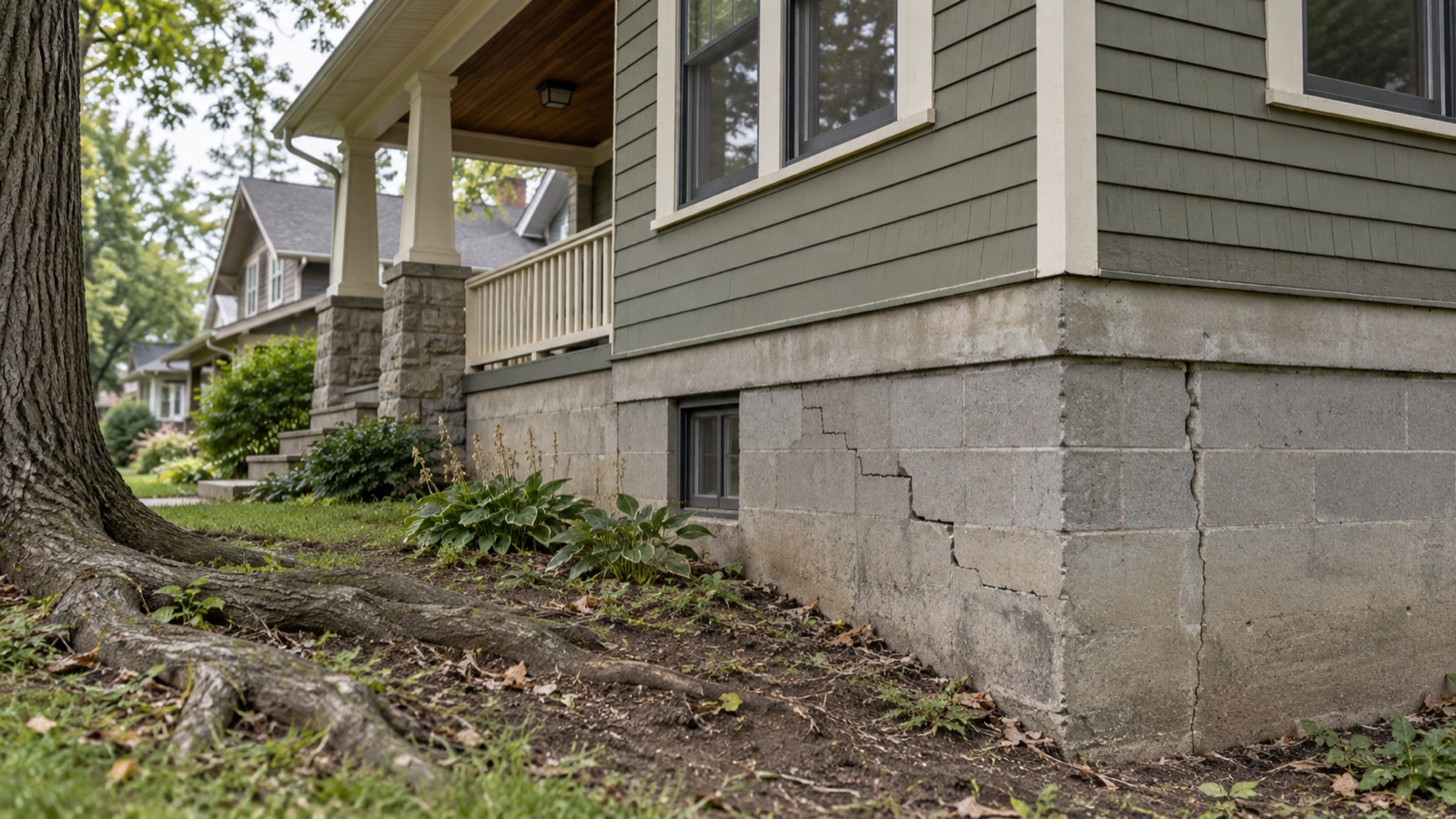
Foundation repair in Minneapolis starts with an accurate diagnosis. Older foundations, mixed glacial soils, deep winter frost, mature trees, and tightly spaced lots can create several different problems that look similar from inside a basement.
The crack is the symptom. The real question is whether the wall is leaking, moving inward, settling, or simply showing normal material shrinkage.
Why Minneapolis Foundations Need Local Diagnosis
Minneapolis has housing from many construction eras. Early 1900s homes may have stone, brick, or concrete block foundations. Later homes commonly use concrete block or poured concrete. Each material cracks and moves differently, so a repair that is appropriate for one foundation may be wrong for another.
Ground conditions also vary across Hennepin County. Glacial deposits can shift from sand and gravel to silt and clay over a short distance. Sandy soils tend to drain quickly but can wash out when water is concentrated near a footing. Clay-rich soils hold more water and can press against a basement wall or change volume as moisture levels rise and fall.
Winter adds another force. Minnesota Department of Labor and Industry guidance uses a conventional minimum footing depth of 3 feet 6 inches in southern Minnesota when a soil engineer has not determined another depth. That requirement reflects the amount of seasonal freezing foundations must resist. Frost can still affect shallow slabs, exterior steps, additions, and poorly drained soil beside the house.
Warning Signs That Deserve Attention
Not every crack means structural failure. Look at the crack pattern, width, location, and whether it is changing.
Cracks and wall movement
- Horizontal cracks can indicate pressure pushing inward against a basement wall.
- Stair-step cracks through block mortar joints can point to settlement or wall movement.
- Vertical cracks may be shrinkage cracks, but they need evaluation if they widen, leak, or show displacement.
- A wall that bows or leans is a structural concern, even when the visible crack looks small.
Our guide to foundation crack types explains which patterns are usually less concerning and which call for prompt inspection.
Changes elsewhere in the house
Foundation movement does not stay in the basement. Watch for doors that begin sticking, windows that no longer sit square, sloped floors, gaps between walls and trim, or repeated drywall cracks above the same section of foundation. One sign alone may have another cause. Several related signs make foundation movement more likely.
Water and surface drainage
Water at the wall-floor joint, mineral deposits, peeling paint, or recurring dampness can show that water is building pressure outside the wall. Gutters, downspouts, soil slope, sump performance, and drain tile condition should be checked before assuming the foundation itself needs major structural work.
Match the Repair to the Cause
A useful inspection should separate four common problem classes.
- A stable crack that leaks. A contractor may recommend an appropriate crack injection or seal after confirming the wall is not actively moving.
- A block or poured wall moving inward. Depending on the amount of movement and the wall condition, stabilization may use carbon fiber, steel reinforcement, anchors, or a more extensive rebuild.
- A footing or section of the home settling. Underpinning or piering may transfer the load to stronger bearing material. The system must be designed for the actual structure and soil conditions.
- Water management driving the damage. Downspout changes, corrective grading, drain tile, sump improvements, or exterior waterproofing may be part of the repair. Structural work without controlling the water source leaves the same pressure in place.
This is why estimates based only on a photo or crack width are unreliable. A proper foundation repair inspection connects the visible damage to its cause before recommending materials or a repair system.
What Foundation Repair Costs in Minneapolis
Foundation repair prices span a wide range because the phrase covers everything from sealing one stable crack to stabilizing an entire wall or underpinning part of a house.
For planning purposes, a limited crack repair may run from several hundred dollars into the low thousands. Wall stabilization often costs several thousand dollars. Widespread settlement repair, difficult excavation, or a project involving multiple systems can exceed $20,000.
The biggest cost drivers are:
- Repair method and amount of material required
- Linear feet of affected wall or number of support points
- Finished basement demolition and restoration
- Exterior access between nearby Minneapolis homes
- Engineering, permit, and inspection requirements
- Drainage or waterproofing work needed with the structural repair
Published averages are useful for setting expectations, but they cannot price a specific house. See our detailed Minnesota foundation repair cost guide for common repair ranges, then get a written scope based on an on-site inspection.
What to Ask Before Hiring a Contractor
The contractor should explain what moved, why it moved, and how the proposed repair addresses that cause. Ask these questions before signing:
- What evidence supports the diagnosis?
- Is the wall or footing still moving?
- Does the scope include the water or soil condition that contributed to the problem?
- Are engineering or City of Minneapolis permits needed?
- What parts of the basement or yard will be disturbed?
- What warranty applies, and is it transferable?
- What could change the price after work begins?
Choose a properly licensed Minnesota contractor and compare written scopes, not just totals. A lower bid is not a bargain if it treats a leaking crack while ignoring an inward-moving wall.
Get a Clear Answer About Your Minneapolis Foundation
If you see a new crack, a bowing wall, recurring basement water, or changes in floors and doors, document the condition and schedule an inspection. Early evaluation gives you more options and helps separate routine maintenance from a structural repair.
Concrete & Foundation Solutions provides free inspections for Minneapolis homeowners. Call 651-364-4400 or request an inspection online to get a clear diagnosis and a repair plan based on your home.
Related Services
Have a Foundation Concern?
Get a free, honest inspection from a local team with 20+ years of Twin Cities experience.
Call 651-364-4400