
Foundation problems are stressful, and the cost question is usually the first thing homeowners want answered. The honest answer is that foundation repair in Minnesota covers a wide range, from a few hundred dollars for a minor crack to well over $20,000 for significant structural work. The difference depends on what is actually wrong, how bad it has gotten, and the conditions of your specific home.
This guide breaks down realistic cost ranges by repair type, explains what drives prices up or down, and tells you what to expect from the process.
What Affects Foundation Repair Cost
No two foundation problems are identical. Several factors determine where a job lands on the price spectrum.
Severity and extent of damage. A hairline crack in a poured concrete wall is a very different job from a wall that is bowing inward or a corner that has settled several inches. Early-stage problems almost always cost less to fix than ones that have been ignored for years.
Type of foundation. Poured concrete, concrete block, and stone foundations all respond differently and require different repair methods. Block repair in particular has its own set of techniques because the mortar joints and individual blocks both have to be addressed.
Access. A finished basement adds cost because drywall, flooring, or built-ins may need to be removed to reach the problem. Unfinished basements are significantly easier and cheaper to work in.
Soil conditions. Minnesota soils vary considerably. Expansive clay soils (common across much of the East Metro) absorb water, swell, and then shrink as they dry out. That freeze-thaw cycle puts repeated stress on foundations and can accelerate damage. Sandy or loamy soils behave differently. Contractors need to understand what they are working with before recommending a repair method.
Linear footage. For repairs measured by length, including wall stabilization and drain tile systems, the total linear footage of the affected area is a primary cost driver.
Cost Ranges by Repair Type
These are realistic ranges based on common repair types. Your actual cost could be lower or higher depending on the factors above.
Minor Crack Injection
Small, non-structural cracks in poured concrete walls are often repaired by injecting polyurethane or epoxy into the crack to seal it against water infiltration.
- Typical range: $300 to $1,000 per crack, depending on depth, length, and location
- Best suited for cracks that are stable and not actively moving
- Does not address underlying structural issues if they exist
Carbon Fiber Wall Stabilization
When a basement wall is bowing or leaning inward, carbon fiber straps are anchored to the floor and the rim joist above to halt movement and restore some stability.
- Typical range: $3,000 to $8,000, depending on the number of straps and linear footage of wall treated
- Does not push the wall back to plumb but stops further inward movement
- Less invasive than excavation-based repairs
- Works well for early to moderate bowing (generally under 2 inches)
Wall Anchors and Bracing Systems
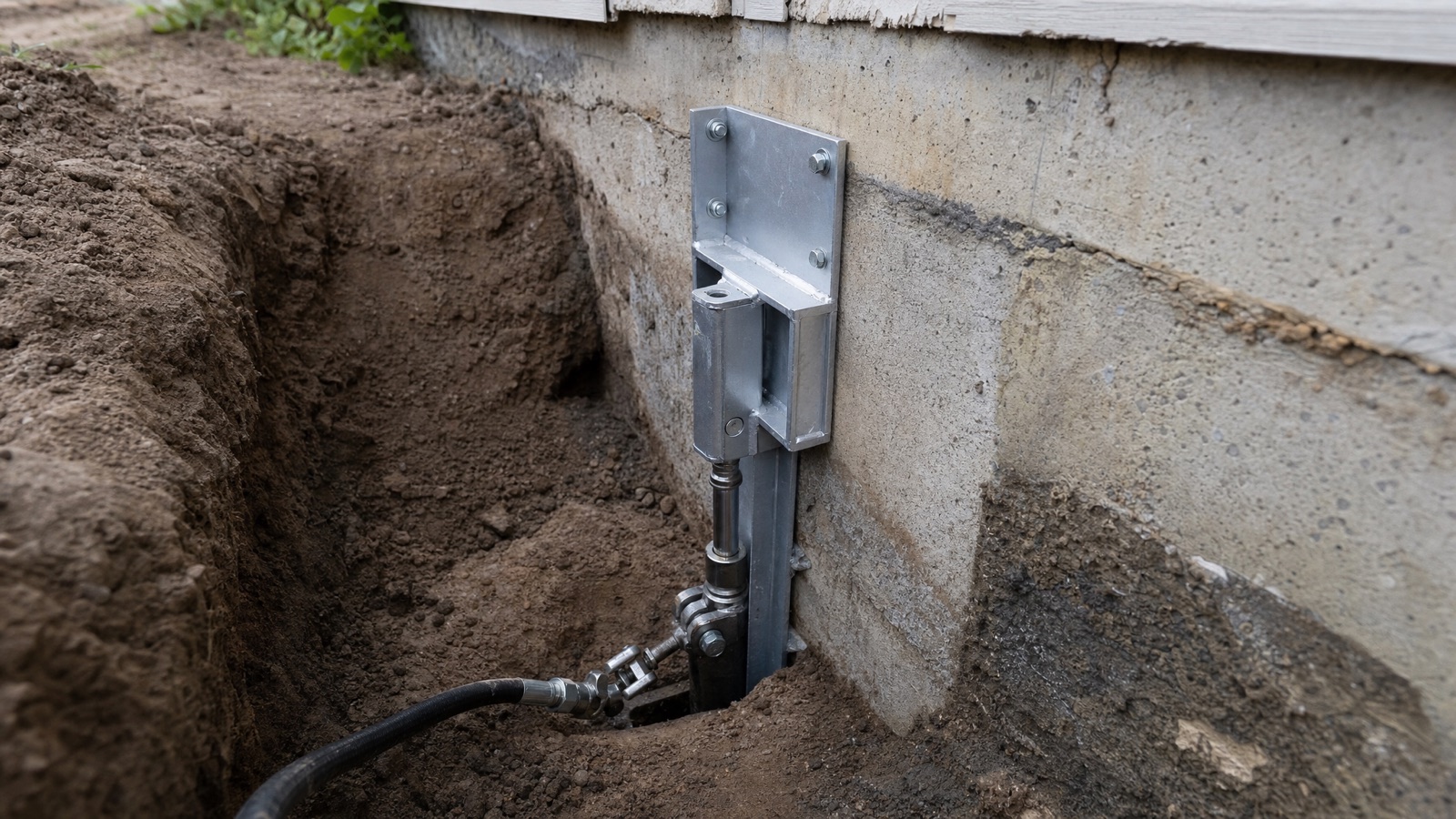
For more significant lateral movement, wall anchors driven into stable soil outside the foundation can be used to stabilize and, over time, gradually straighten the wall.
- Typical range: $4,000 to $10,000 depending on number of anchors and excavation required
- May require some exterior excavation for anchor installation
- Allows incremental tightening as soil conditions permit
Underpinning and Piering
When a foundation is settling due to inadequate soil support, steel push piers or helical piers are driven down to bedrock or load-bearing strata to stabilize and potentially lift the structure.
- Typical range: $10,000 to $30,000 or more for a full piering job
- Cost scales with number of piers required and depth needed to reach stable soil
- This is the repair type for significant settlement, unlevel floors, or doors and windows that have stopped closing properly
Interior Drain Tile Systems
When groundwater is consistently entering through the floor or wall-floor joint, an interior drain tile system channels water to a sump pit before it can cause damage.
- Typical range: $5,000 to $15,000 for a full perimeter system
- Priced largely by linear footage
- Finished basements cost more because of demo and restoration work
- Often combined with a new or upgraded sump pump
Major Structural Repair
Jobs involving significant excavation, replacement of deteriorated block or concrete, waterproofing membrane installation on the exterior, or combinations of multiple repair types can run $15,000 to $40,000 or more. These are not common scenarios, but they do happen, particularly in older homes with neglected problems.
Why No Honest Contractor Can Quote You Over the Phone
This is worth saying plainly: a foundation repair estimate that does not include an in-person inspection is not a real estimate.
Foundation problems look different from the outside than they are on the inside. A crack visible from the interior may be superficial or it may reflect significant soil movement. Bowing in a block wall may be early-stage or it may be near failure. The only way to know is to see it, measure it, and often probe the soil around it.
Any contractor willing to give you a firm price over the phone based on your description is either guessing or using a number designed to get in the door rather than reflect the actual scope of work. Neither is good for you.
At Concrete & Foundation Solutions, every estimate starts with a free on-site inspection. We look at the problem, take measurements, and give you a written scope of work and price before any commitment is made. Call 651-364-4400 or contact us to schedule yours.
Managing the Cost with Financing
Foundation repair is not a purchase most homeowners plan for in their budget. For jobs that run into the thousands, financing can make the difference between addressing a problem now and watching it get worse.
We work with Regions Home Improvement Financing, which offers:
- Same-as-cash options at 6 months and 12 months for qualifying projects
- Fixed-rate financing at 7.99% APR over 5 years for longer repayment timelines
Addressing a foundation problem early almost always costs less than waiting. A wall that needs carbon fiber straps today may need full excavation and replacement in five years. Financing lets you act on a problem before it becomes a larger one. See our financing options for details.
What to Do Next
If you are seeing cracks, water intrusion, bowing walls, sticking doors, or uneven floors, those are signs worth taking seriously. Minnesota’s freeze-thaw cycles are hard on foundations, and most problems do not get better on their own.
The first step is getting an accurate picture of what you are dealing with. Our team has been serving the Twin Cities East Metro and St. Croix Valley for over 20 years. We will tell you what we see, what we recommend, and what it will cost, no pressure and no guessing.
Call 651-364-4400 or visit our foundation repair page to learn more about what we do and to request your free inspection.
Related Services
Have a Foundation Concern?
Get a free, honest inspection from a local team with 20+ years of Twin Cities experience.
Call 651-364-4400