
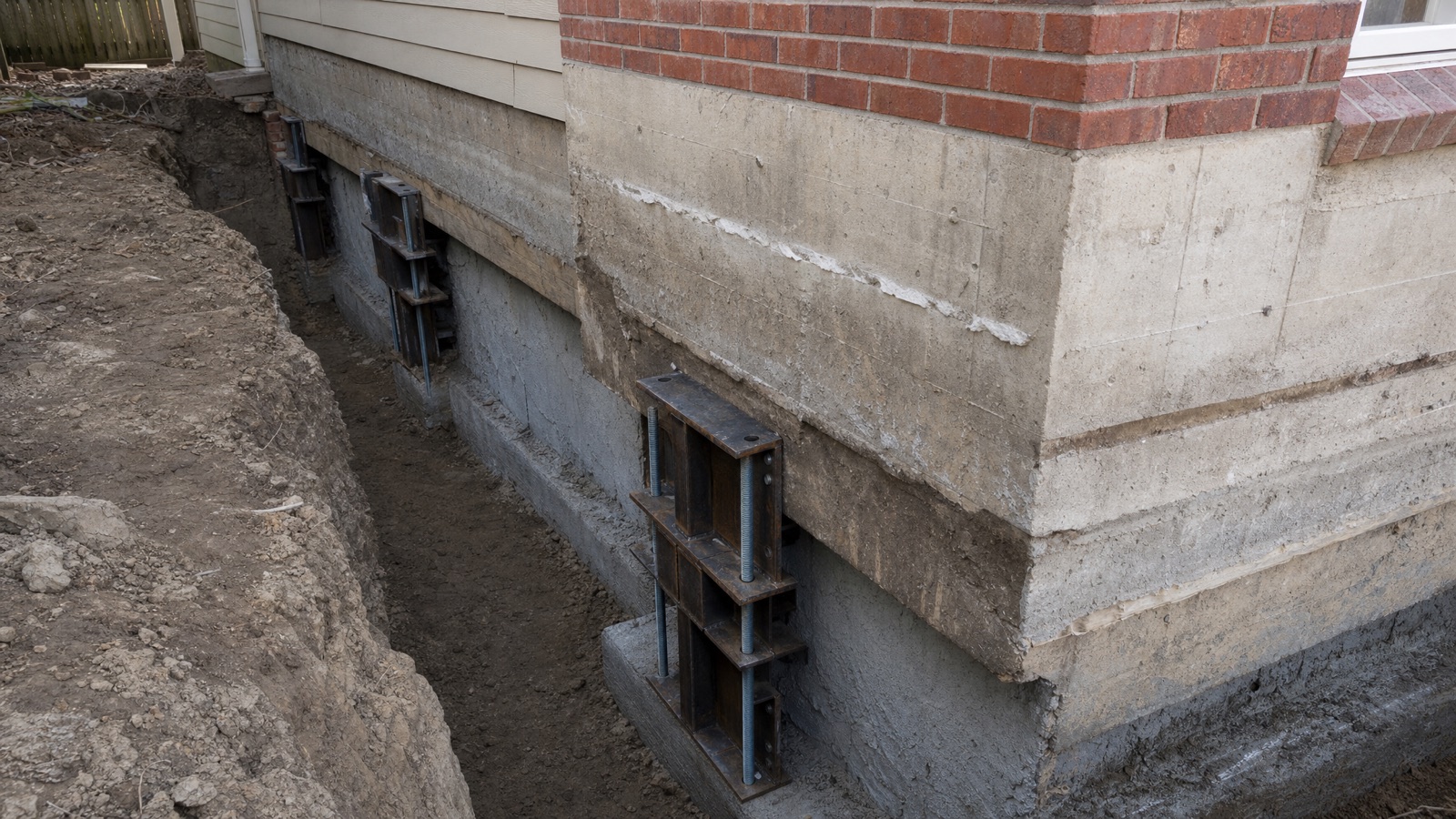
Foundation settling is one of those problems that tends to sneak up on homeowners. A door that used to swing freely starts sticking. A floor that felt level develops a noticeable slope toward one corner. A crack appears above a window that was not there last spring. These are not cosmetic issues. They are symptoms of movement in the structure that supports your entire home.
Understanding what causes settling, how to recognize it early, and what underpinning actually involves can help you make a clear-headed decision when the time comes.
What Causes a Foundation to Settle
The ground under a Minnesota home is not static. Several conditions contribute to foundation movement over time.
Clay soil expansion and contraction. Much of the Twin Cities and East Metro sits on clay-heavy soil. Clay absorbs water and swells. It dries out and shrinks. Repeated seasonal cycles of expansion and contraction create movement that the foundation above it has to absorb. Over years, that movement accumulates.
Poor compaction of fill soil. Many subdivision lots, particularly those built out in the last few decades across the East Metro, involved significant grading. When fill soil is not compacted thoroughly before construction, it continues to compress under the weight of the house for years after the home is built. Corners and lower sections of the foundation tend to drop first.
Drainage problems and soil washout. Water that pools against the foundation or flows toward the house instead of away from it saturates the soil below the footing. Saturated soil loses load-bearing capacity. In some cases, water actively carries soil particles away from beneath the foundation, leaving voids that allow sudden drops in elevation.
Natural soil consolidation. Even well-compacted soil consolidates gradually under sustained load. This is more common in areas with organic material in the subsoil or where the original ground conditions were not well documented before construction.
How to Recognize Foundation Settling
Settling leaves recognizable patterns. Knowing what to look for helps you act before minor movement becomes a major structural problem.
- Diagonal cracks from window and door corners. Settling puts stress on the corners of openings first. A stair-step crack running from a corner at roughly 45 degrees is a strong indicator of differential movement.
- Doors and windows that stick or no longer close squarely. When a frame racks slightly out of plumb or square due to settling, the hardware and edges bind.
- Floors that slope toward one area of the house. A slope you can feel when walking, or that becomes visible when you set a marble on the floor, often corresponds to a section of foundation that has dropped relative to the rest.
- Gaps between the wall and ceiling, or the wall and floor. These gaps appear when framing members that used to be in contact separate as the structure shifts.
- Sinking corners on the exterior. Visible steps in the foundation itself, or brickwork that has separated, are late-stage signs that movement has been happening for some time.
If you are seeing two or more of these, a professional inspection is worth scheduling. Foundation repair is far more manageable when caught early.
How Underpinning Works
Underpinning is the process of extending the foundation’s support down to stable soil or bedrock, bypassing the compromised material that has been causing movement. The two most common methods are steel push piers and helical piers.
Steel Push Piers
Steel push piers are driven straight down through the problem soil using hydraulic equipment that pushes against the weight of the structure itself. Crews dig to expose the footing, bracket the pier to the foundation, and drive pier sections down in increments until they reach the resistance of load-bearing strata. The pier is then locked in place and the load of the foundation transfers to it.
Because the house provides the resistance needed to drive the piers, this method works best on structures with enough dead weight to push against. For most full-basement homes in the Twin Cities, push piers are a reliable and time-tested solution.
Helical Piers
Helical piers use a different approach. They are steel shafts with helical plates welded along their length, and they are literally screwed into the ground using torque rather than being pushed down. This makes them well-suited for lighter structures, additions, decks, porches, or situations where the foundation cannot generate enough downward resistance for push piers.
Helical piers can also be installed before construction to pre-stabilize areas with known soil problems, though retrofit applications are the more common scenario in residential work.
Stabilization and Potential Lift
Once piers are set, hydraulic equipment engages the entire system simultaneously. In many cases, controlled lift is achievable, bringing the settled section of the foundation back toward its original elevation. The degree of recovery depends on how long settling has been occurring and the condition of the surrounding structure. We discuss realistic expectations with every homeowner before work begins.
When Piering Is the Right Call
Not every crack or settlement sign requires piering. Hairline cracks from concrete curing, minor surface spalling, or isolated block deterioration may be addressed with simpler repairs. Block repair or targeted patching can be the appropriate fix when the underlying soil is stable and the movement has stopped.
Piering is the right call when:
- Movement is ongoing and measurable
- Settling is concentrated in one area of the foundation, indicating uneven soil support
- The structure has already dropped enough to cause functional problems indoors
- A drainage correction alone will not address the loss of bearing capacity that has already occurred
If you are preparing to sell, a pre-sale home foundation review can help you understand what needs to be disclosed, what can be addressed before listing, and what a buyer’s inspector is likely to flag.
Get a Free Inspection
Concrete & Foundation Solutions has served the Twin Cities East Metro and St. Croix Valley for more than 20 years. We offer free inspections with no obligation. If your home is showing signs of settling, the earlier you get eyes on it, the more options you have.
Call 651-364-4400 or contact us to schedule your inspection.
Related Services
Have a Foundation Concern?
Get a free, honest inspection from a local team with 20+ years of Twin Cities experience.
Call 651-364-4400