
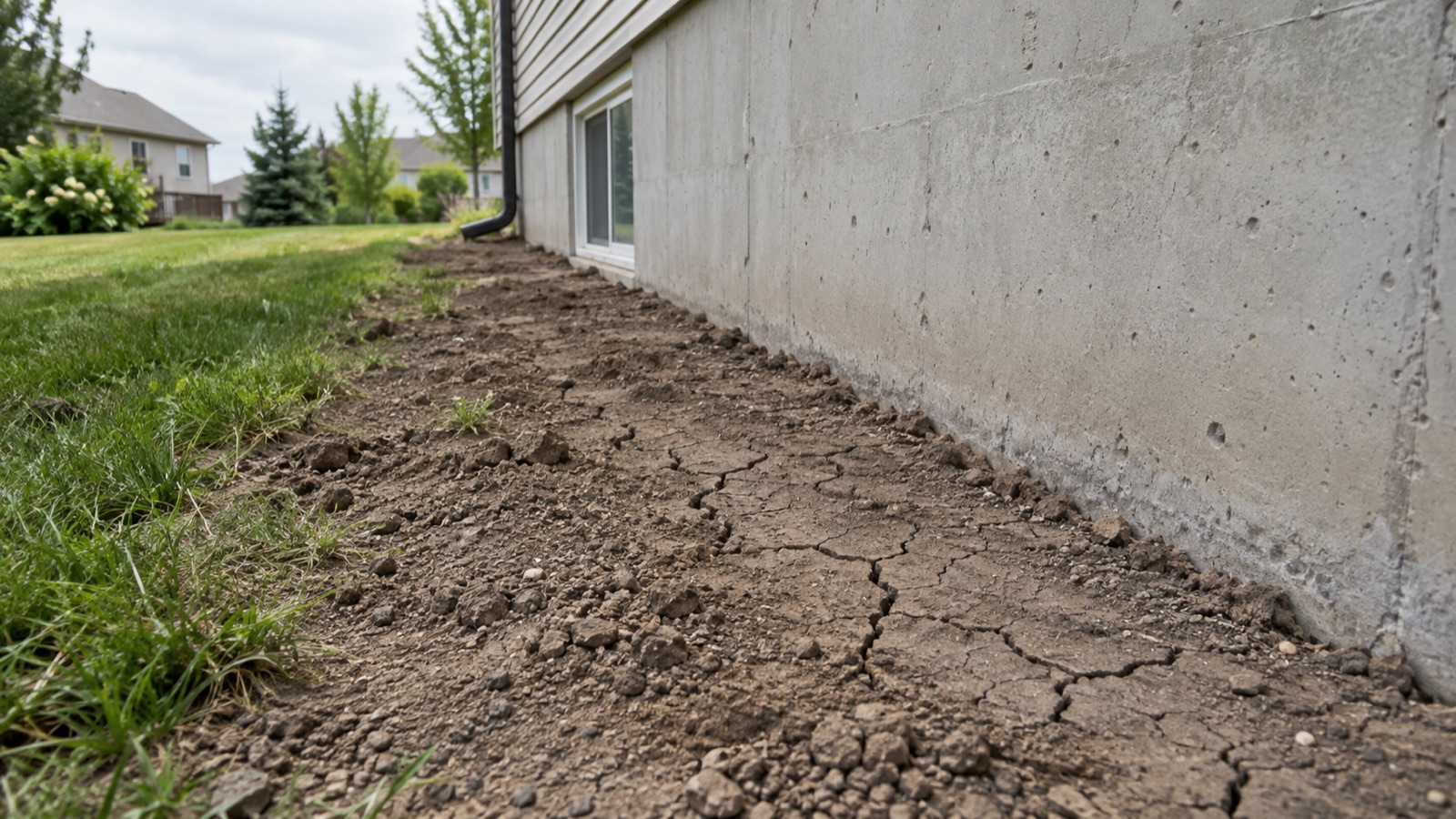
Clay soil can be hard on a foundation because its volume changes as its moisture changes. Some clay-rich soils expand when they become wet and shrink as they dry, creating repeated movement beside or beneath a home. In the Twin Cities, seasonal rain, dry spells, snowmelt, grading, and roof runoff can all change that moisture balance.
That does not mean every foundation crack is caused by expansive clay. Soil conditions vary across the metro and even from one lot to the next. The useful question is whether soil movement, drainage, and the crack pattern point to an active foundation problem.
What makes clay soil expand and shrink?
Clay is made of very small mineral particles. Water can enter the spaces around those particles, and certain clay minerals change volume more than others. The USDA Natural Resources Conservation Service explains that shrink-swell potential depends on both the type and amount of clay in the soil. Smectite-rich clays generally have greater volume-change potential than other clay minerals.
The cycle matters more than one wet day or one dry week:
- Wet soil expands. Rain, snowmelt, irrigation, leaking utilities, or a short downspout can add moisture near the foundation.
- Dry soil contracts. Heat, drought, and nearby vegetation can pull moisture from the ground.
- Uneven moisture creates uneven support. One side or corner of a home may experience more movement than another.
- Repeated cycles can show up in the structure. Cracks may open, close, return after patching, or appear alongside changes in floors, doors, and windows.
Minnesota’s climate supplies both sides of that cycle. The Minnesota Department of Natural Resources notes that nearly two thirds of the state’s annual precipitation falls from May through September, but dry spells and drought also occur. That variation can produce large moisture swings in exposed or poorly drained soil.
Why Twin Cities soil conditions vary by property
The Twin Cities landscape was shaped by glaciers. Minnesota DNR describes preglacial river channels in the metro that were later filled with glacial till. Till is a mixed deposit that can contain clay, silt, sand, gravel, and larger material. That mix is one reason a homeowner should not assume every property behaves the same way.
The Minnesota Geological Survey publishes county geologic atlases with maps of surficial geology and subsurface sediment. Washington County, which includes Woodbury, has its own atlas, but a county-scale map still cannot diagnose the soil immediately beside one foundation. Imported fill, excavation, backfill, lot grading, and later landscaping can all affect how water and soil behave at the house.
The NRCS Web Soil Survey is useful for learning about mapped soil units and their engineering interpretations. For a repair plan, field observations and site-specific testing carry more weight than a broad map.
Warning signs worth investigating
Expansive soil does not leave one unique crack that proves the cause. The conditions below are signs of foundation movement or water pressure that can have several causes, including soil moisture changes. Look for patterns and changes over time:
- Stair-step cracks in concrete block, especially when mortar joints are displaced
- Horizontal wall cracks or inward bowing, which can indicate lateral soil pressure
- Vertical cracks that widen, shift, or reopen after a cosmetic patch
- Gaps between soil and the foundation during dry weather, followed by concentrated water entry during rain
- Doors and windows that begin sticking along with new drywall or masonry cracks
- Uneven floors or separation at trim and cabinets near the affected area
- Recurring basement moisture after heavy rain or spring snowmelt
Seasonal change can be useful evidence. Take dated photos from the same angle and measure an accessible crack at the same location. Our guide to foundation crack types explains how vertical, horizontal, and stair-step patterns differ. Monitoring helps an inspector understand the history, but it is not a substitute for evaluating the wall and soil conditions together.
Water management is part of foundation protection
You cannot change the mineral makeup of the soil around an existing home, but you can reduce abrupt and uneven moisture changes. Start with the water you can control.
Maintain positive grading
Ground that is flat or slopes toward the house directs rain and snowmelt to the foundation. University of Minnesota Extension recommends a minimum slope of 1 inch per foot for at least 6 feet away from the wall. Corrective grading can restore that path when settled backfill, landscaping, or hardscape sends water the wrong way.
Move roof runoff away
Clean gutters and working downspouts keep concentrated roof water from soaking one section of soil. UMN Extension recommends discharging downspout extensions at least 4 feet beyond the wall. Our guide to gutters and downspouts covers the full roof-water path.
Fix concentrated water sources
Check for low spots, leaking hose bibs, irrigation aimed at the house, plumbing leaks, and window wells that collect water. A constantly wet pocket beside otherwise dry soil can create uneven pressure and movement.
Do not confuse clay movement with frost heave
Both involve soil and water, but they are not identical. Expansive clay changes volume with moisture. Frost heave occurs when water in freezing soil forms ice lenses and lifts the ground. Minnesota homes can experience both, so compare the timing with our frost heave and foundations guide if movement follows a strong winter pattern.
What an inspection should determine
A useful inspection connects the visible damage to a cause. It should consider crack direction and displacement, wall alignment, exterior slope, downspout discharge, water entry, floor changes, and whether nearby additions or slabs are moving separately from the main foundation.
The repair should then match the problem. Drainage or grading may reduce future pressure, but it will not straighten a wall that has already bowed. Crack sealing may control a stable leak, but it will not stabilize active movement. Structural reinforcement, rebuilding, or support beneath a settling area may be necessary when the foundation itself has shifted. Our foundation repair service explains the repair categories we evaluate.
Get a site-specific answer
Expansive clay is a mechanism, not a diagnosis. A map, a dry-soil gap, or a crack can raise a useful question, but the right solution depends on what is happening at your home.
Concrete & Foundation Solutions provides free inspections across the Twin Cities East Metro and St. Croix Valley. If cracks are changing, a wall is bowing, or water keeps collecting near the foundation, call 651-364-4400 or request an inspection. We will evaluate the structure, drainage, and soil conditions before recommending a repair.
Sources
Related Services
Have a Foundation Concern?
Get a free, honest inspection from a local team with 20+ years of Twin Cities experience.
Call 651-364-4400