
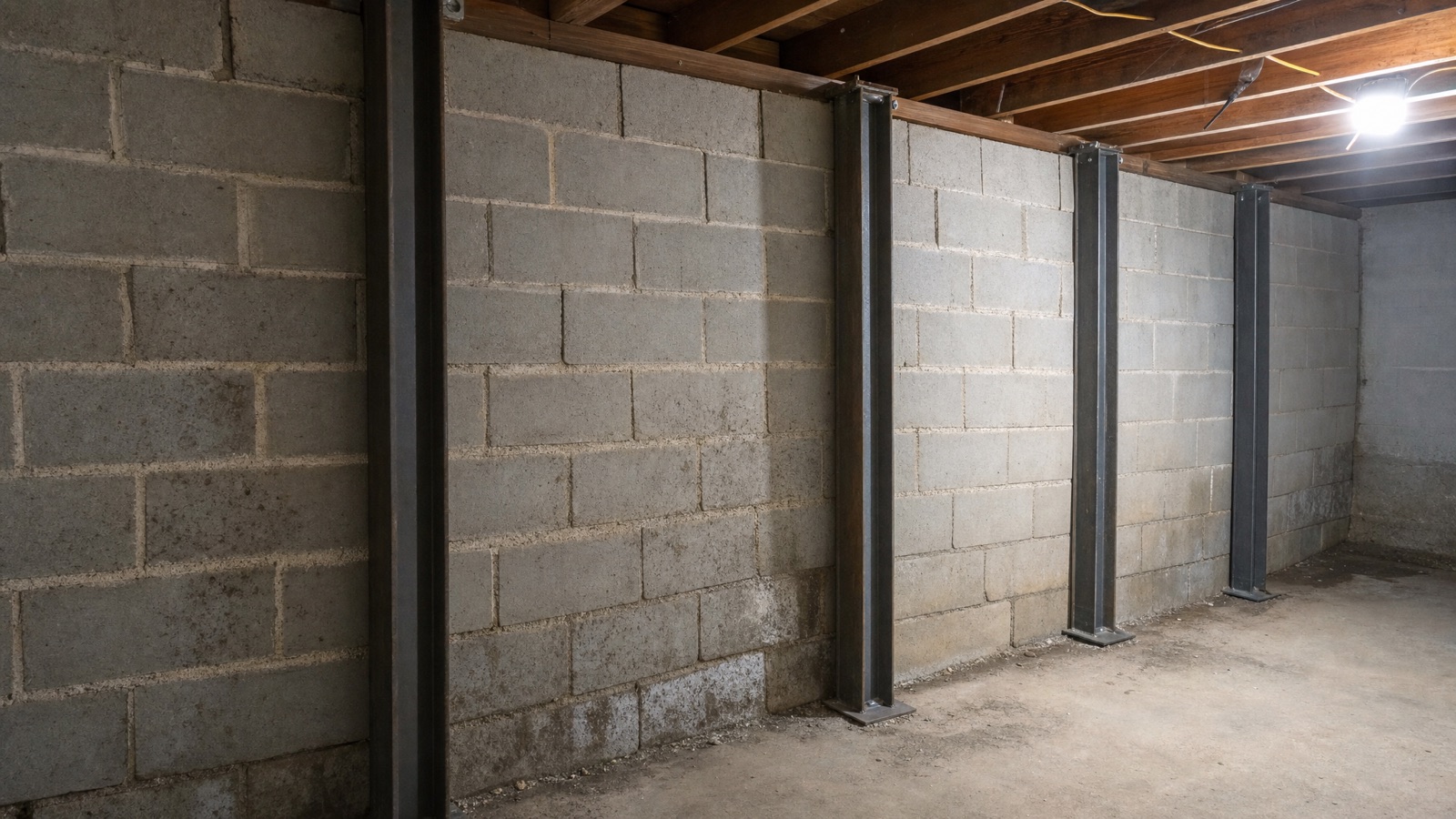
A bowing basement wall is one of those problems that tends to get noticed and then ignored, because the wall is still standing and the house still feels solid. That instinct is wrong. A wall that is bowing is under active pressure, and that pressure does not go away on its own. Understanding why walls bow and what your repair options actually are will help you make a clear-headed decision before the problem gets worse.
Why Basement Walls Bow
Basement walls, whether poured concrete or concrete block, are built to handle vertical loads from the structure above. What they are not built to resist forever is persistent lateral pressure from the outside.
Several forces work together to push walls inward:
- Lateral soil pressure. The weight of soil against the wall increases with depth. Saturated soil is significantly heavier than dry soil.
- Hydrostatic pressure. When water accumulates in the soil around the foundation and has nowhere to drain, it pushes against the wall with considerable force.
- Freeze-thaw cycles. Minnesota winters are hard on foundations. Water in the soil expands when it freezes, pushing against the wall, then contracts when it thaws. Repeated cycles over years cause incremental movement.
- Clay soil expansion. Much of the Twin Cities and East Metro sits on clay-heavy soil. Clay absorbs water and expands, then shrinks when dry. This seasonal movement puts the foundation through repeated stress cycles.
Block walls are particularly vulnerable because the hollow cores and mortar joints create natural weak points. Poured concrete walls tend to bow as a unit rather than crack along joints, but they are not immune.
How to Measure Severity
The key measurement is deflection, which is how far the wall has moved from its original vertical position. A plumb line or straight edge held against the wall at multiple points gives you a baseline. A wall that has moved less than 1 inch is considered minor. Between 1 and 2 inches is moderate. Anything beyond 2 inches is severe and narrows your repair options considerably.
You should also look at the crack pattern. Horizontal cracks running across a block wall (especially near the midpoint of the wall height) are a classic sign of lateral bending. Stair-step cracks along mortar joints indicate a different stress pattern. Either way, a foundation repair inspection is the right starting point before you commit to any solution.
Carbon Fiber Straps: The Case for Minor to Moderate Bowing
Carbon fiber straps are the preferred solution when bowing is under approximately 2 inches and the wall has not fractured severely. Here is why they work well in that range:
- High tensile strength. Carbon fiber is stronger than steel by weight. Once anchored at the top and bottom of the wall, the strap resists further inward movement effectively.
- No excavation required. The entire installation happens inside the basement. There is no disruption to landscaping, driveways, or exterior grading.
- Low profile. The straps are thin and can be painted over or concealed behind finished wall materials.
- Stabilization, not correction. This is important to understand. Carbon fiber straps stop further movement. They do not push the wall back to its original position. If straightening is a goal, that requires a different approach.
Carbon fiber is not the right tool for a wall that has already moved significantly. At that point, the forces involved exceed what a strap system can reliably hold.
Steel I-Beams and Wall Anchors: For More Severe Cases
When deflection is beyond 2 inches, or when the wall structure itself has been compromised, steel I-beams (sometimes called wall braces) or helical wall anchors are more appropriate.
Steel I-beams are floor-to-joist systems. A steel beam is installed vertically against the bowing wall, anchored at the floor and at the floor joist above. This provides rigid support and, in some cases, allows for gradual straightening over time by tightening the system seasonally. The trade-off is that they are visible and take up wall space.
Helical wall anchors involve drilling through the wall and installing steel rods that extend horizontally into the soil, where a helical plate anchors into stable ground. These can be tensioned to pull the wall back toward plumb. They require some excavation or access to the exterior, but far less than a full dig.
For block walls showing significant deterioration in addition to bowing, block repair may be needed alongside structural correction to restore integrity before or after the stabilization work.
When a Wall Needs to Be Rebuilt
In the worst cases, where the wall has moved dramatically, fractured through, or deteriorated to the point where repair is not structurally sound, the answer is a full rebuild. This means removing the existing wall and replacing it. It is a significant project, but it is sometimes the only option that gives you a reliable, long-term result.
The Role of Drainage and Grading
Any bowing wall repair is incomplete without addressing why the wall is bowing. If water is pooling against the foundation due to poor grading or inadequate drainage, that pressure will continue after the repair. Corrective grading and surface drainage improvements are often part of a complete solution. Fixing the wall without fixing the water is a short-term answer to a long-term problem.
Getting the Diagnosis Right
The biggest mistake homeowners make is choosing a repair method before understanding the full picture. A wall that looks like a carbon fiber strap candidate from across the room might show 2.5 inches of deflection when measured carefully. That changes everything about the recommended approach.
Concrete & Foundation Solutions offers free inspections throughout the Twin Cities East Metro and St. Croix Valley. If your basement wall looks off, or if you want to know what you are actually dealing with, contact us or call 651-364-4400. We will give you a straight assessment and a repair recommendation that fits the actual condition of your foundation, not a one-size-fits-all sales pitch.
Related Services
Have a Foundation Concern?
Get a free, honest inspection from a local team with 20+ years of Twin Cities experience.
Call 651-364-4400